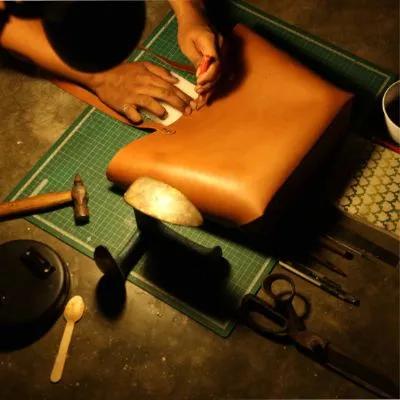


Geography of Touch: Types of Leather we Use at The Bicyclist.
Leather in Our Designs
There is no such thing as "the one perfect leather."
Most brands buy their leather the way one might buy office supplies—in bulk, driven by convenience, with a terrifying lack of imagination. But when your design ethos relies on minimalist utility and sharp geometry, the material is a part of the architecture. You cannot build a strong structurally defined laptop bag out of the same hide you’d use for a slouchy, body-hugging sling. It would be a functional disaster.

So instead of pointing at a cosmetically finished, one leather fits all principal and working with whatever is convenient, at The Bicyclist, we select the leather based on the design requirements.
Our sourcing taps into four major states and six distinct leather hubs across India, each with its own specialty of the tanning arts:

Tamil Nadu:
When we are crafting a wallet, we look to the tanners in Ranipet and Dindigul. Famous for their "East India" (EI) vegetable-tanned leather, these hides are exactly what you want in your pocket. They start rigid, but over time, they absorb the natural oils of your hand, softening and developing a spectacular, highly personal patina.
 Howrah Bridge, Kolkata, West Bengal, India by Pritishi Dutta
West Bengal:
The Leather Complex in Bantala near Kolkata is the known for its bovine (cow and buffalo) ovine (sheep) and caprine (goat) leather in both wet blue (chrome tanned leather and crust (dried veg tanned leather) . When we need reliability and consistency, for our everyday carries, large corporate orders and white label production requests this is where we turn to source our leather from.
 Photo of Kanpur Central Railway Station Building (Cant Side View), Kanpur, Uttar Pradesh, India by By KpinfomediaIndia - Own work
Uttar Pradesh:
Then there’s Kanpur. Traditionally, this city built its reputation on serious, heavy-duty saddlery leather, the tough, thick and durable stuff. But surprisingly enough, it’s also exactly where we source our incredibly soft sheep nappa.
 Devi Talab Mandir, Jalandhar City, Jalandhar, Punjab, India by By Shivamsetu - Own work
Punjab:
And when we are sketching out accessories that need to feel buttery and yielding right out of the box, our search naturally leads us to the specialized tanners up in Jalandhar.
Surface Finishes of our Leather: The Tactile Spectrum
Sourcing the right hide, whether it’s a tough, durable yet stiffer buffalo leather, or a naturally softer, more stretchable cowhide, is only the beginning. How it feels in your hands, and the tactile experience of using a leather product, comes down to the surface finish.

Now, let’s clear up a common misconception: the finish doesn’t actually depend on the animal. You’ll find these same finishes on both our buffalo and cow leathers. And to be perfectly clear, a surface finish doesn’t reflect the leather’s grade (full-grain, split, or suede). It’s exactly what it sounds like: a surface treatment applied at the very end of the tanning process. The Bicyclist specifically use only full grain hides that have gone through these surface finishing process, though they can be used on other grades as well. (As a quick side note, our softer sheep and goat leathers do have slightly different finishing requirements.)

For our main bovine leathers, we rely on four specific surface finishes. We chose each one based entirely on how we want the final bag or wallet to feel, function, and look in your everyday life.

Drum Dyed:
Submerged and tumbled in a drum of pigmented color, this is our most foundational finish. This process allows the color to penetrate the leather, creating consistent tone through every layer of the hide. With no heavy surface coating, it can feel slightly dry straight out of the drum—so we hand-polish it to bring out its natural, earthy softness. It’s leather at its most honest, and the least forgiving of stains.
Designs that use Drum Dyed Leather

Semi-Pigmented:
Life is messy: latte spills, oily fingers, and sudden downpours can stain even the most carefully maintained leather totes and shoulder bags. To avoid those surprises, we use semi-pigmented leather, which starts as a drum-dyed leather and then receives a whisper-light topcoat. This not only softens the appearance of minor natural blemishes, but also adds a gentle layer of protection for when the world gets unpredictable.
Designs that use Semi-Pigmented Leather
- Classic Bifold Card Wallet in Black
- Bifold Card Wallet in Black
- Long Wallet in Navy Blue
- Valet Tray in Off White

NDM (Naturally Dry Milled):
This is the most recognizable of the finishes, a classic surface texture that most people associate with leather. To achieve it, after the tanning process, the hides are tumbled in massive drums without water. This breaks down the rigid fibers, creating a sublimely soft, yielding material with a natural, organic pebbled texture.

Crunch Leather:
Treated with two layers of clear dye, this finish preserves the hide’s natural topography while adding a polished, protective sheen. The result is a crinkled, vintage texture that looks beautifully broken-in the moment you pick it up.
Designs that use Crunch Leather
- Card Case in Tan
- Notebook Case in Tan
- Belle Sling Bag in Tan Crunch
- Esemrelda Sling Bag in Tan Crunch
Though there are many more leather finishes, like aniline, semi-aniline, Printed Dry Milled (PDM), and Oil Pulled, we don’t use them all, as we don’t always align with the processes used to make them or the surface finishes they create.
The Antidote to Throwaway Culture
In an era defined by peeling synthetic plastics and seasonal trends destined for the landfill, choosing a material that actually outlives its first decade is a quiet act of defiance. We live in a world obsessed with the "new," but leather is one of the few materials that rewards you for keeping it, and using it regularly.

Unlike man-made alternatives that begin their life at their absolute peak and slowly degrade into ruin, the leather used in ‘The Bicyclist’ do the exact opposite. A high veg-tan wallet doesn’t just hold your cards; it absorbs your habits. A buffalo leather tote yields, bends, and softens to the specific rhythm of your commute. The personalized patina that develops is not wear and tear—it is a visual diary of every café table it has rested on. It is the ultimate antidote to throwaway culture because it is fundamentally irreplaceable.
The Sensory Anchor
We spend an extraordinary amount of our day interacting with flat, frictionless glass screens. While our digital lives are endlessly efficient, they can also feel somewhat hollow. Physical objects, however, serve as vital anchors. They are intimately tied to our sensory experiences—the earthy, familiar scent of a newly unboxed leather bag, the distinct weight of it in your hand, or the sound of a heavy brass zipper. These sensory details give us a much richer, more three-dimensional experience of life.
Furthermore, physical objects act as vessels for our personal memories in a way that a file saved in the cloud simply cannot. A digital photo of a trip might get buried in your camera roll, but the small water stain on your leather weekender or the way your wallet has molded to the exact shape of your back pocket? Those are tangible, enduring reminders of where you have been.
When we talk about our leather finishes, we aren't just thinking about aesthetics; at The Bicyclist, we are thinking about the daily tactile reality. When you frantically reach blindly into your bag to find your keys in the dark, the softly pebbled surface of our NDM leather feels forgiving against your knuckles. Conversely, a Crunch leather wallet feels immediately familiar, sliding effortlessly out of a jacket pocket.

Ultimately, it comes down to the geometry of comfort. Comfort isn't just about softness; it is about how a product physically behaves. When we design a laptop bag, we use stiffer, thicker leathers so it stands upright on the floor next to your desk, offering rigid dependability. But when we design a casual sling bag to wear across your chest, we reach for softer materials like sheep nappa so it molds naturally against your ribs as you walk.
The geometry of the design dictates the leather we choose, ensuring that the object works with your life, offering a profound sense of familiarity every single time you pick it up.